
Planning peak travel in London? Get practical airport and UK port transfer tips for Heathrow, Gatwick, Luton, Stansted, Portsmouth and more.
Peak travel in London can turn a simple airport journey into a time-sensitive part of your trip. During school holidays, summer travel, Christmas, New Year, bank holidays and major events, London's airports, roads, railway stations and UK ports can become considerably busier.
For visitors arriving at Heathrow, Gatwick, Stansted, Luton or London City Airport, choosing the right transfer is about more than finding the cheapest option. Your arrival time, luggage, destination, traffic conditions, terminal, group size and onward travel plans can all affect the journey.
The same applies if you are travelling from London to a cruise or ferry port. A flight arriving in London may only be the first part of your journey. If your final destination is Southampton, Portsmouth, Dover, Tilbury or another UK port, your transfer needs to account for the complete route.
This guide explains how to plan London airport transfers during busy travel periods and how to reduce common problems when travelling between airports, hotels and UK ports.
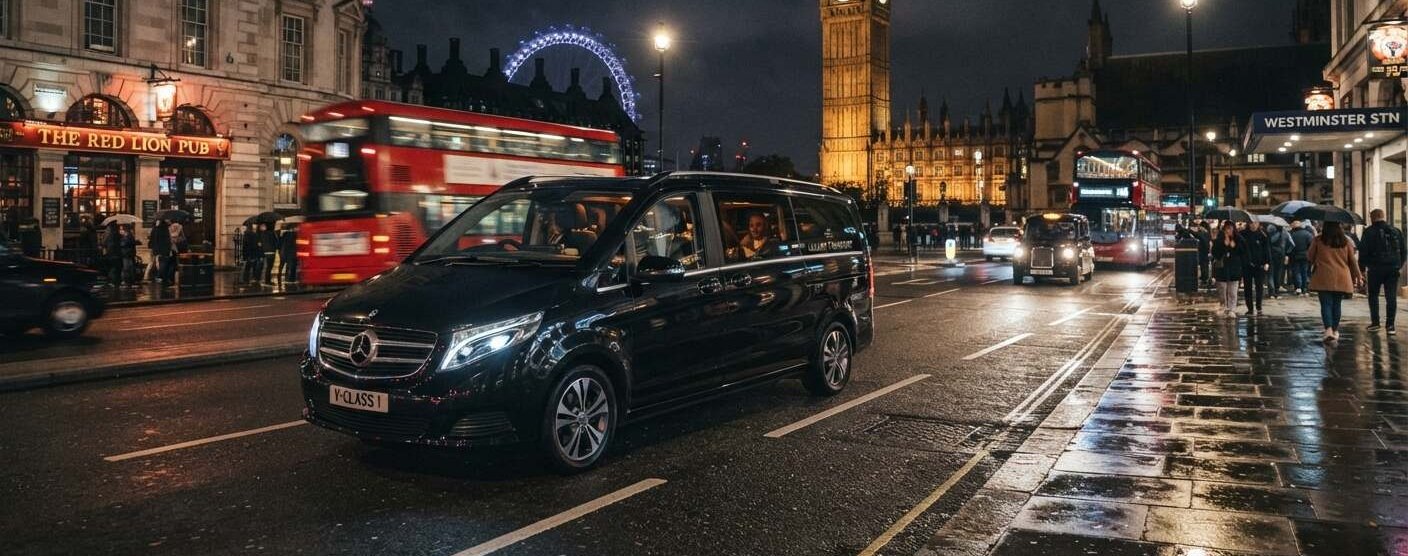
During peak travel periods, book your airport or port transfer in advance, allow additional road and airport time, provide your flight number, select a vehicle that accommodates your luggage, and check your terminal and destination carefully.
For direct journeys, a pre-booked minicab or private transfer can be useful because you can travel door to door without changing between trains, coaches and local transport.
Public transport can still be practical for many airport-to-central-London journeys. Heathrow, Gatwick and Stansted have dedicated rail services, while Heathrow and London City are connected to the London Underground or wider TfL network.
For airport-to-port journeys, however, the most convenient option may depend heavily on your schedule and luggage.
London does not have one single peak travel season. Different parts of the year create different types of demand.
Common busy periods include:
Easter holidays
May bank holidays
Summer school holidays
July and August
October half-term
Christmas and New Year
Bank holiday weekends
Major sporting events
Concerts and festivals
Large exhibitions and conferences
Airport traffic can also become particularly challenging during weekday commuter periods.
For road journeys, the morning and evening rush hours can add significant time to an airport transfer. One recent London transfer analysis places typical weekday road peaks around approximately 07:00 to 09:30 and 16:30 to 19:00, although actual conditions vary by route and day.
The important point is simple: do not plan a peak-period transfer using an off-peak journey time.
Busy travel periods affect more than the airport itself.
A journey can be delayed by:
Traffic congestion
Roadworks
Accidents
Airport drop-off congestion
Long queues at immigration
Baggage delays
Security queues
Train disruption
Coach delays
Weather
Flight delays
Large events in London
High passenger demand
Heathrow specifically advises passengers travelling between airports to allow extra time for passport control, baggage collection, check-in, security, waiting and possible traffic or service delays.
This is especially important when your airport transfer is connected to a cruise or ferry departure.
Heathrow Airport (LHR) is west of central London and is one of the UK's major international gateways.
During busy periods, passengers should check their terminal before travelling. Heathrow has multiple passenger terminals, and your pickup or drop-off arrangements can depend on the terminal you use.
For travellers heading into central London, options include the Elizabeth line, Heathrow Express, Underground services, coaches, taxis and private transfers. Visit London's current airport guide lists Heathrow's rail and Underground connections alongside coach and taxi options.
Allow extra road time. The M4, M25 and roads around west London can become congested.
Check your terminal. Do not assume all Heathrow terminals use the same pickup arrangements.
Give your flight number when booking. This can help the transfer provider coordinate the pickup with the expected arrival.
Consider luggage. Families or groups with several suitcases may need a larger vehicle.
Avoid unnecessarily tight connections. If you are transferring from Heathrow to another airport, allow time for baggage, passport control and the journey between airports.
For passengers looking for a direct journey, a Minicab London airport transfer can provide a pre-booked alternative to changing between public transport services.
Gatwick Airport (LGW) is south of London and has North and South terminals.
During peak holiday periods, Gatwick can become particularly busy because of its large leisure and international passenger base.
Passengers should confirm their terminal before booking a transfer.
Make sure you know whether your departure is from the North or South Terminal.
Allow additional time for airport access during busy periods.
Book airport transportation before travelling during school holidays.
Consider luggage space when choosing your vehicle.
Leave additional time if travelling onwards to a cruise port.
Keep your flight number and arrival details available.
Gatwick has rail services towards central London, including Gatwick Express, Southern and Thameslink services.
However, travellers heading directly from Gatwick to Portsmouth or Southampton may prefer to compare a direct road transfer with a multi-stage public transport journey.
For passengers specifically looking for an airport taxi London Gatwick service, advance booking can help establish the pickup arrangements before arrival.
Stansted Airport (STN) is northeast of London and is widely used by passengers travelling on European and short-haul routes.
The Stansted Express connects the airport with Liverpool Street, while coach and private transfer services provide alternatives.
During peak travel, the main consideration is often the distance between Stansted and your final destination.
If you are staying in central London, compare the full door-to-door journey rather than looking only at the airport train fare.
For a family travelling with several bags, a pre-booked minicab can eliminate the need to carry luggage through stations and make multiple changes.
London Luton Airport (LTN) is north of London and serves a large number of leisure and European routes.
Rail services connect with Luton Airport Parkway, while coaches and taxis provide other options. The Luton Airport Express rail connection also links the airport with central London services.
If travelling during school holidays:
Confirm your flight terminal and departure time.
Check the journey from your accommodation to the airport.
Allow additional road time.
Consider luggage when comparing train and minicab options.
Book your airport transfer ahead of your departure.
A London Luton Airport taxi service can be particularly useful when travelling from accommodation that is not conveniently located near the rail network.
London City Airport (LCY) is located in east London and is particularly convenient for passengers travelling to areas such as Canary Wharf, the City of London, Stratford and Docklands.
Its DLR connection provides access to London's wider public transport network.
Because London City is closer to central and east London than the larger airports, the transfer may be shorter for many local destinations.
However, peak road conditions can still affect journeys. Do not assume that a short distance automatically means a short journey.
Southend Airport (SEN) is another airport serving the wider London region and Essex.
It is connected to London Liverpool Street by rail, with Stratford also providing a useful connection.
When comparing flights, remember to calculate the complete journey.
A cheaper flight from an airport further from your accommodation may not necessarily produce the lowest overall travel cost once transport, time and luggage are considered.
Airport-to-port journeys need more planning than ordinary airport-to-hotel transfers.
Imagine your flight lands at Heathrow at 8:00 am and your cruise departs from Southampton later that day.
Your available transfer time is not simply the time between 8:00 am and your cruise check-in.
You may need time for:
Immigration
Passport control
Baggage collection
Customs
Finding your driver
Loading luggage
Airport traffic
Motorway traffic
Rest stops
Cruise terminal check-in
This is why passengers should avoid creating an itinerary that depends on everything running exactly on schedule.
Heathrow to Southampton is a popular airport-to-cruise route.
Travellers can use public transport or book a direct private transfer.
For passengers with several bags or children, a door-to-door vehicle can remove the need to move luggage between airport, station and train.
During peak cruise periods, consider booking the transfer as soon as your flight and cruise details are confirmed.
Portsmouth is another important UK port for cruise and ferry passengers.
A direct transfer from Heathrow can avoid travelling into central London before heading south towards the coast.
When travelling during a busy period, allow additional time for road conditions and port check-in.
Gatwick is already south of central London, making it an important arrival airport for passengers continuing towards Portsmouth and the south coast.
Travellers should compare direct road transportation with public transport based on luggage, group size and departure time.
The Portsmouth transfer service is an option for passengers arranging a pre-booked journey to Portsmouth.
Gatwick to Southampton is another route used by cruise passengers.
The journey crosses areas where traffic conditions can change throughout the day, so a transfer should not be planned around the minimum theoretical driving time.
If your cruise has a fixed check-in deadline, build a reasonable buffer into the itinerary.
London travellers may also need transportation to:
Dover is in Kent and is an important cruise and ferry gateway.
Travellers from Heathrow, Gatwick and central London should consider both the distance and traffic conditions when planning the journey.
Tilbury is east of London on the River Thames and can be convenient for passengers staying in parts of east London.
Harwich is in Essex and serves cruise and ferry passengers.
For passengers arriving at Stansted, the location can make Harwich particularly relevant when planning an airport-to-port journey.
There is no universal number of minutes that works for every airport-to-port journey.
Instead, build your schedule around the entire journey.
Consider:
Flight arrival → immigration → baggage → driver pickup → road journey → port arrival → cruise check-in
If your flight is international, allow additional time after landing.
If your journey falls during a school holiday or bank holiday, allow additional road time.
If you are travelling on a cruise departure day, avoid making your plan dependent on a very small buffer.
A cruise ship's departure time is fixed. Your airport transfer needs to work backwards from the required port arrival time.
Both options can be useful.
Public transport can work well when:
You are travelling alone
You have light luggage
Your destination is near a major station
Your arrival time is flexible
You are comfortable changing services
London's airports have several rail, Underground and coach connections.
A pre-booked minicab can be useful when:
You have several suitcases
You are travelling with children
You have a group
Your accommodation is away from a station
You are travelling late at night
You are travelling directly to a port
You want a door-to-door journey
You have a fixed onward schedule
The most suitable option depends on each traveller’s individual needs. The important factor is matching the transport method to your itinerary.
For ordinary travel, booking ahead gives you time to confirm your route, passenger numbers and vehicle.
For peak travel, advance booking becomes more important.
Consider booking as soon as your travel dates are confirmed if you are travelling during:
Christmas
New Year
Easter
Summer holidays
Bank holidays
School half-term
Major London events
Busy cruise periods
Do not wait until you arrive at the airport if you already know you need a specific vehicle or a direct airport-to-port journey.
A flight number can be useful for an airport transfer because the expected arrival time can change.
Flights may arrive early or late, and the time spent leaving the aircraft, collecting luggage, and completing airport formalities can vary.
A professional transfer provider may use the flight information to coordinate the pickup, depending on its service policy.
Always check the provider's exact waiting-time and flight-monitoring terms before booking.
Vehicle size becomes especially important during holidays.
A family travelling with two adults, two children, two large suitcases, hand luggage and a pushchair may require considerably more luggage space than a couple travelling with two cabin bags.
Before booking, provide:
Number of adults
Number of children
Number of suitcases
Number of cabin bags
Pushchairs
Wheelchairs
Special luggage
Child-seat requirements
For larger groups, consider an MPV or passenger van rather than trying to fit everyone and everything into a standard saloon.
A journey that normally takes 45 minutes may take considerably longer during heavy traffic.
Always check your travel time against the expected departure period.
A cheap flight from Stansted, Luton or Gatwick may not remain the cheapest option after adding the cost and time of getting to your destination.
Compare the complete journey.
Heathrow and Gatwick have multiple passenger terminals.
Check the terminal before booking and again before travelling.
Passenger numbers and luggage numbers are both important.
A vehicle that technically accommodates your passengers may not have enough space for everyone's luggage.
Airport delays and road congestion are outside your control.
Give yourself a sensible buffer before port check-in.
If you are travelling from an airport directly to a southern port, entering central London first can add an unnecessary part of the journey.
Check direct airport-to-port options.
Before travelling, check the following:
Flight number
Arrival airport
Terminal
Flight arrival time
Hotel address
Cruise or ferry port
Port check-in time
Number of passengers
Luggage quantity
Vehicle size
Child-seat requirements
Transfer pickup point
Driver contact details
Traffic conditions
Alternative route options
Train or coach disruption
Flight delay information
Save your booking confirmation and transfer contact details somewhere accessible before you leave home.
The easiest way to plan a busy London transfer is to work backwards.
Begin by working out when you need to be at your destination.
Then calculate:
Port or destination deadline → road journey → airport exit time → baggage and immigration → flight arrival
After establishing your timeline, choose between public transport and a private transfer based on your travel needs.
For a straightforward trip into central London with light luggage, public transport may be perfectly suitable.
For a family travelling with multiple suitcases from Heathrow to Southampton on a cruise departure day, a direct pre-booked transfer may simplify the journey.
The right option depends on your destination, luggage, budget, travel time and group size. Public transport can be efficient for many airport-to-central-London journeys, while a pre-booked minicab can provide direct door-to-door transportation.
London experiences increased travel demand during school holidays, Easter, summer, Christmas and New Year, bank holidays and major events. Weekday morning and evening road traffic can also increase journey times.
Pre-booking is sensible if you need a specific pickup time, vehicle type or direct airport-to-port journey. It also gives you time to confirm the booking details before travelling.
It depends on your cruise port, flight availability and starting location. The most important factors are the total journey time, traffic, luggage, flight arrival time and required port check-in time.
For a broader airport comparison, see the guide to London Gatwick vs Heathrow and Stansted.
Yes. Direct airport-to-Portsmouth transfers can be arranged, depending on the provider and vehicle availability. A direct journey can avoid unnecessary changes through central London.
Yes. Pre-booked airport minicabs are available for Gatwick journeys. During busy periods, passengers should provide their flight number, terminal, passenger count and luggage requirements.
The answer depends on your airport, flight arrival time, port, traffic and cruise check-in deadline. Build enough time for airport procedures, baggage collection and possible road delays rather than relying on the shortest estimated driving time.
Families may find a direct private transfer convenient when travelling with children, luggage, pushchairs or multiple bags. The vehicle should be selected based on both passenger numbers and luggage.
Check your transfer provider's flight-monitoring and waiting-time policy and contact the provider if necessary. Keeping your flight number on the booking can help coordinate the airport pickup.
Peak travel in London requires a slightly different approach to ordinary airport transportation.
Finding a vehicle at the airport is only part of planning your journey. It is to plan the complete journey from your departure point to your final destination.
Check the airport, terminal, flight number, luggage, traffic conditions, transfer method and onward schedule before travelling. If you are continuing to a UK cruise or ferry port, work backwards from your required arrival time at the port.
A little advance planning can help you avoid unnecessary changes, reduce luggage handling and give yourself more time when London's airports and roads are at their busiest.
Minicab Lane LTD provides pre-booked minicab and airport transfer services for passengers travelling across London and to destinations including UK airports, hotels, railway stations and seaports.
The service covers airport journeys involving Heathrow, Gatwick, Stansted, Luton, London City and other London-area airports, as well as transfers to destinations such as Portsmouth.
For airport transfers, airport taxi bookings, London-to-port journeys or other pre-booked minicab services, contact Minicab Lane LTD on +44 7768 718332.
Address: 5A Stork Rd, London E7 9HR, United Kingdom
©2026 Minicab Lane | Developed by Fugenservices




 Secured by
PositiveSSL
Secured by
PositiveSSL